Reminder: Readings are your responsibility. You will be expected to come to class prepared, having read the material, and ready to participate in the discussion
Key aspects of the syllabus and Latte
- “Skills”
- Assessment
- Moodle
- Course web site - book summaries
We are talking about IDEAS!
- You need to have a notion of how the business would work
- You also need to evaluate the technology risk
- Remember to look for big pains!
- To more research, googling, talking to your friends, thinking about your own experiences, family and acquaintances!
- Did you read the article on Paul Graham’s website?
Discussion about Paul Graham’s (PG) Article
- The Objective of this discussion is to reinforce the key ideas from the article and get different perspectives
- Break into random groups of 6 for 10 minutes to discuss the article
- Each student should say up front whether they read the article
- Discuss the following questions in the group
- When we come back together each group should have decided on one student to speak and report back on the questions below.
Discussion Questions
- Considering PG’s idea of a graph with the x-axis people who want the product; y-axis how badly they want it
- Why would google look like an immense crater, Facebook like a Deep narrow Well?
- Come up with two other well known products and discuss what their PG graph would look like.
- What does PG mean by the Schlep filter? Is it a good or bad thing?
- How about the Unsexy filter?
- Did this article make you feel more excited about trying entrepreneurship, or more intimidated?
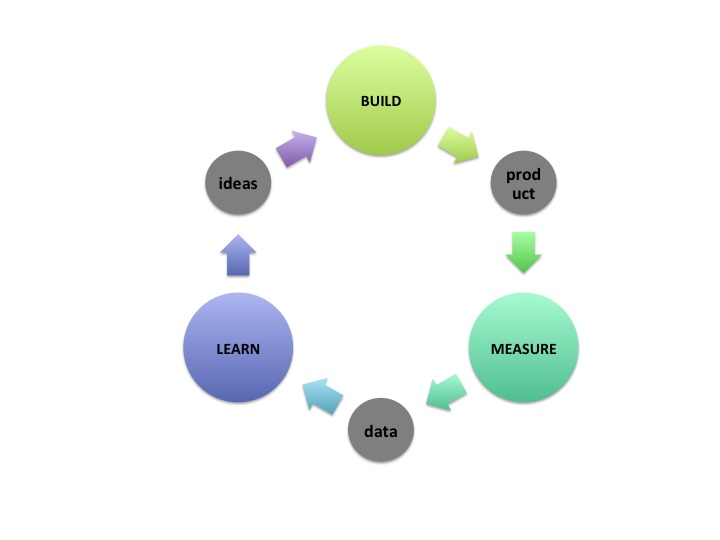
Build Measure Learn
One of the big ideas of Lean Startup Chapter 1: Start
- Decide what your goals are right now (they change over time!)
- Analyze them to determine metrics for growth and success
- Loop to tune the engine of growth:
- Measure current metrics
- Conduct Experiments to try and move reality towards
- Rinse and repeat until you have tuned your engine
- AKA: “Iterating”
AKA: “Validated Learning”
- Kind of like a scientific method
- Form a hypothesis
- Gather data to validate or invalidate it
- Update your design, beliefs, assumptions, based on data
Build Measure Learn
Ask questions
- Are you making your product better?
- How do you know?
- Are the changes you are making affecting the measures you care about?
- How do you decide what measures you care about?
- Back to first principle: “Is this a business or a hobby?”
Basic pattern
- Use an Minimum Viable Product to get real data to test a belief
- Make a series of micro changes (parallel or serial)
- Measure whether metrics are better or worse
- When you feel like you are not making real progress
- Perhaps pivot if micro changes are not moving the needle in the right direction
- Start with the highest return (cost/risk/reward) assumption
Thank you. Questions? (random Image from picsum.photos)